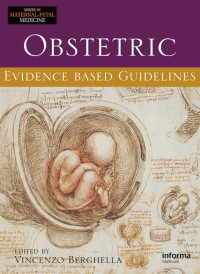
EBOOK
Obstetric Evidence Based Guidelines
To me, pregnancy has always been the most fascinating and
exciting area of interest, as care involves not one, but at least
two persons – the mother and the fetus – and leads to the
miracle of a new life. I was a third-year medical student,
when, during a lecture, a resident said: ‘I went into obstet
rics because this is the easiest medical field. Pregnancy is a
physiology process, and there isn’t much to know. It’s sim
ple’. I knew from my ‘classic’ background that ‘obstetrics’
means to ‘stand by, stay near’, and that indeed pregnancy
used to receive no medical support at all.
After almost 20 years practicing obstetrics, I know now
that while physiologic and at times simple, obstetrics and
maternal–fetal medicine can be the most complex of the
medical fields: pregnancy is based on a different physiology
than for non-pregnant women and can include any medical
disease, require surgery, etc. It is not so simple. In fact, igno
rance can kill, in this case with the health of the woman and
her baby both at risk. Too often I have gone to a lecture,
journal club, rounds, or other didactic event to hear pre
sented only one or a few articles regarding the subject, with
out the presenter reviewing the pertinent best literature and
data. It is increasingly difficult to read and acquire all the
knowledge that is published, certainly in obstetrics, with
over 20 journals publishing on this subject. Some residents
or even authorities would state at times that ‘there is no evi
dence’ on a topic. Indeed, we used to be the field with the
worst use of randomized trials.1 As the best way to find
something is to look for it, my co-authors and I searched for
the best evidence. On careful investigation, we found data
on almost everything we do in obstetrics, especially on our
interventions. Indeed, our field is now the pioneer for a
number of meta-analyses and extension of work for evi
dence based reviews.2 Obstetricians are now blessed with
lots of data, and should make the best use of it.
The aims of this book are to summarize the best evi
dence available in the obstetrics and maternal–fetal medi
cine literature, and make the results of randomized trials
and meta-analyses easily accessible to guide clinical care.
The intent is to bridge the gap between knowledge (the evi
dence) and its easy application. To reach these goals, we
reviewed all trials on effectiveness of interventions in
obstetrics. Millions of pregnant women have participated
in thousands of properly conducted randomized con
trolled trials (RCTs). The efforts and sacrifice of mothers
and their fetuses for science should be recognized at least
Table 1 Obstetric evidence
Table 1 Obstetric evidence
>600 current Cochrane reviews
Hundreds of other current meta-analyses
Thousands of RCTs
Millions of pregnant women randomized
by the physicians’ awareness and understanding of these
studies. Some of the trials have been summarized in over
600 Cochrane reviews, with hundreds of other meta-analy
ses also published in obstetric topics (Table 1). All of the
Cochrane Reviews, other meta-analyses and trials in
obstetrics and maternal–fetal medicine were reviewed and
referenced. The material presented in single trials or meta
analyses is too detailed to be readily translated to advice for
the busy clinician who needs to make dozens of clinical
decisions a day. Even the Cochrane Library, the undis
cussed leader for evidence based medicine efforts, has been
criticized for its lack of flexibility and relevance in failing to
be more easily understandable and clinically readily
usable.3 It is the gap between research and clinicians that
needed to be filled, making sure that proven interventions
are clearly highlighted, and are included in today’s care. All
pilots fly planes under similar rules to maximize safety; by
analogy, all obstetricians should manage all aspects of
pregnancy with similar, evidence based rules. Indeed, only
interventions that have been proven to provide benefit
should be used routinely. On the other hand, primum non
nocere: interventions that have clearly been shown to be
not helpful or indeed harmful to mother and/or baby
should be avoided.Another aim of the book is to make sure
the pregnant woman and her unborn child are not penal
ized by the medical community. In most circumstances,
medical disorders of pregnant women can be treated as in
non-pregnant adults. Moreover, there are several effective
interventions for preventing or treating specific pregnancy
disorders.
Evidence based medicine is the concept of treating
patients according to the best available evidence. While
George Bernard Shaw said: ‘I have my own opinion, do not
confuse me with the facts’, this can be a deadly approach,
especially in medicine, and may compromise two or more
lives at the same time in obstetrics and maternal–fetal med
icine. What should be the basis for our interventions
Table 2 Why did we write this book?
Many aims:
• Improve the health of women and their children
• ‘Make it easy to do it right’
• Clinical best care
• Research ideas
• Education
• Develop lectures
• Decrease disease, use of detrimental interventions,
therefore costs
• Reduce medico-legal risks
in medicine? Meta-analyses allow summarizing of the
best research data available. As such, they provide the best
guidance for ‘effective’ clinical care.4 It is unscientific and
unethical to practice medicine or to teach or conduct
research without first knowing all that has already been
proven.4 In the absence of trials or meta-analyses, lower
level evidence is reviewed. This book aims at providing a
current systematic review of the evidence, so that current
practice and education, as well as future research, can be
based on the full story from the best-conducted research,
not just the latest data or someone’s opinion (Table 2).
These evidence based guidelines cannot be used as a ‘cook
book’, or a document dictating the best care. The knowledge
from the best evidence presented in the guidelines needs to
be integrated with other knowledge gained from clinical
judgment, individual patient circumstances, and patient
preferences, to lead to best medical practice. These are
guidelines, not rules. Even the best scientific studies are not
always perfectly related to any given individual and clinical
judgment must still be applied to allow the best ‘particular
izations’ of the best knowledge for the individual, unique
patient. Evidence based medicine informs clinical judg
ment, but does not substitute it. However, it is important to
understand that greater clinical experience by the physician
actually correlates with inferior quality of care, if not inte
grated with knowledge of the best evidence.5 The appropri
ate treatment is given in only 50% of visits to general
physicians.5 At times, limitations in resources may also limit
the physicians’ knowledge. Guidelines and clinical pathways
based on evidence not only point to the right management
but also can decrease medico-legal risk.6
We aimed for brevity and clarity. Suggested management
of the healthy or sick mother and child is stated as straight
forwardly as possible, for everyone to easily understand
Table 3 Who is this book for?
Table 3 Who is this book for?
• Generalists
• Residents
• Nurses
• Medical students
• MFM attendings
• MFM fellows
• Other consultants on pregnancy
• Even lay public who wants to know ‘the evidence’
• Politicians responsible for health care
and implement (Table 3).If you find the Cochrane Reviews,
scientific manuscripts and books difficult to ‘translate’ into
care of your patients, this book is for you.We wanted to pre
vent information overload. On the other hand, as remarked
by Albert Einstein, ‘everything should be made as simple as
possible, but not simpler’. Key management points are high
lighted at the beginning of each guideline, and in bold in the
text. The chapters are divided into two volumes: one on obstet
rics and one on maternal–fetal medicine. Please contact us
(vincenzo.berghella@jefferson.edu or www.jefferson.edu/
mfm) for any comments, criticisms, corrections, missing
evidence, etc.
I have the most fun discovering the best ways to alleviate
discomfort and disease. The search for the best evidence for
these guidelines has been a wonderful, stimulating journey.
Keeping up with evidence based medicine is exciting. The
most rewarding part, as a teacher, is the dissemination of
knowledge. I hope, truly, that this effort will be helpful to
you, too.
Ketersediaan
Tidak ada salinan data
Informasi Detail
- Judul Seri
-
-
- No. Panggil
-
-
- Penerbit
- USA : Informa UK., 2007
- Deskripsi Fisik
-
258 hlm
- Bahasa
-
English
- ISBN/ISSN
-
9780415432818
- Klasifikasi
-
NONE
- Tipe Isi
-
text
- Tipe Media
-
computer
- Tipe Pembawa
-
unspecified
- Edisi
-
-
- Subjek
- Info Detail Spesifik
-
-
- Pernyataan Tanggungjawab
-
-
Versi lain/terkait
Tidak tersedia versi lain
Lampiran Berkas
Jumlah Pengunjung

Komentar
Anda harus masuk sebelum memberikan komentar
 Karya Umum
  Filsafat
  Agama
Agama  Ilmu-ilmu Sosial
  Bahasa
  Ilmu-ilmu Murni
  Ilmu-ilmu Terapan
  Kesenian, Hiburan, dan Olahraga
  Kesusastraan
  Geografi dan Sejarah